Skip to content


Dry ice blasting can remove many types of industrial contamination, including grease, oil, carbon deposits, adhesives, tar, glue, paint and general production build-up. The process is particularly useful when contamination needs to be removed without introducing water, chemical solvents or abrasive blast media.
The exact result depends on what needs removing and the surface underneath. Some contaminants respond particularly well to dry ice, while heavy corrosion or applications that require the surface itself to be profiled may call for a different cleaning method.
Understanding those differences is important when deciding whether dry ice blasting is right for your equipment, machinery or restoration project.
Grease, oil, carbon deposits, adhesives, glue, tar, paint, soot and production build-up, all removed without water, chemical solvents or abrasive blast media. Heavy, deeply established corrosion is the main exception, where an abrasive method may be more suitable.
Introduction To Dry Ice Blasting
Dry ice blasting uses solid carbon dioxide pellets accelerated towards a contaminated surface using compressed air. When the pellets strike the contamination, the cleaning action helps break its bond with the material beneath.
Pellets Accelerated
Solid CO₂ pellets are propelled towards the contaminated surface using compressed air.
Bond Broken
On impact, the cleaning action helps break the bond between the contamination and the material beneath.
Pellets Sublimate
The pellets change directly from solid CO₂ into gas, leaving no spent blasting media behind.
Because the dry ice disappears during cleaning, only the material removed from the surface needs to be dealt with.
This makes dry ice blasting useful across industrial settings where water, solvents or abrasive media would create additional cleaning work or could be unsuitable for the equipment involved. Ice Blasting Solutions uses the process across sectors including manufacturing, automotive, power generation, printing, plastics, oil and gas, petrochemical operations and fire and smoke restoration.
Common Contaminants & Coatings Dry Ice Blasting Can Remove
The suitability of dry ice blasting depends on the relationship between the contamination and the substrate. A contaminant sitting on a surface may respond differently from corrosion that has affected the metal itself, which is why the material and condition of the asset need to be considered before cleaning begins.
Ice Blasting Solutions uses dry ice blasting for contamination ranging from lighter production debris through to heavy tar and glue residues. Common examples include:
Grease and Oil
Machinery and production equipment can develop layers of oil, grease and other residues during normal operation. Dry ice blasting can remove this build-up without adding water to the equipment.
Carbon Deposits
Carbon and burnt-on deposits are common around industrial machinery, production equipment and other assets exposed to heat or combustion. Dry ice blasting can loosen these deposits while protecting suitable surfaces underneath.
Adhesives, Glue and Tar
Sticky contamination can be difficult and time-consuming to remove manually. Ice Blasting Solutions specifically identifies heavy tar and glue residues among the types of build-up its equipment is used to clean.
Paint and Coatings
Dry ice can also be used for certain paint removal projects. Ice Blasting Solutions uses the process to remove layers of paint while preserving suitable underlying materials, including applications involving brick, wood and stone. The coating, its adhesion and the substrate all affect whether dry ice is the appropriate method.
Soot and Fire Contamination
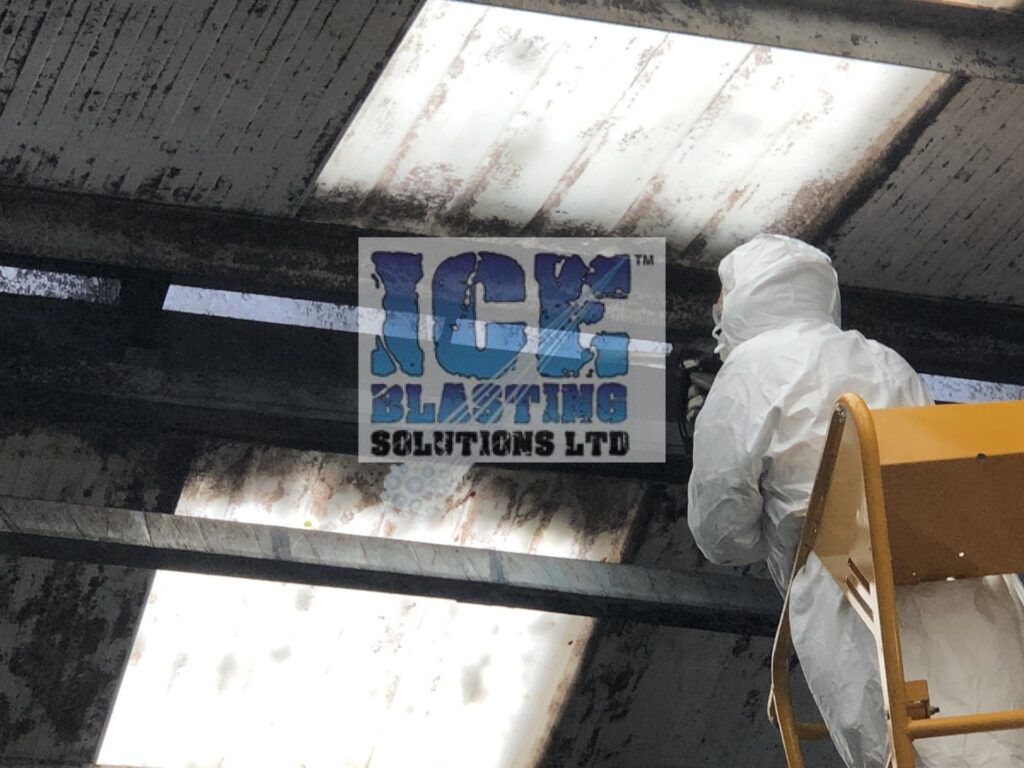
Fire and smoke restoration is another established application offered by Ice Blasting Solutions. The company has used dry ice blasting on fire-damaged properties, including blackened and charred timbers.
Production debris and residues can also accumulate around machinery, moulds and equipment. Dry ice blasting can reach detailed areas that are difficult to clean effectively by hand, making it useful during industrial maintenance.
Rust Removal Capabilities
Whether dry ice blasting can remove rust needs a more careful answer.
The process can help remove loose surface contamination and expose the condition of the metal underneath. Because it is non-abrasive, however, it does not behave in the same way as abrasive blasting when corrosion has become deeply established in the surface.
Where a project involves heavy corrosion or requires a metal surface to be prepared to a particular profile before painting, another process such as industrial sand blasting may be more appropriate.
This distinction matters because removing contamination from metal and mechanically preparing the metal itself are different jobs. The condition of the component should therefore be assessed before deciding which cleaning method to use.
Benefits Of Dry Ice Blasting For Surface Cleaning
Non-Abrasive Cleaning
One of the main advantages of dry ice blasting is its ability to remove contamination without eroding suitable surfaces. Ice Blasting Solutions uses the method on machinery and sensitive areas where switches, panels, wiring, belts and other components may be present.
No Water or Drying Time
The dry process removes the need for water and subsequent drying time. This can be valuable around machinery and electrical components where introducing moisture would be undesirable.
No Secondary Waste
Sand, grit and similar blast media remain at the work area once used. Dry ice pellets turn into gas, so the cleaning media itself does not create an additional waste stream. For paint removal, the material removed from the surface remains to be collected without a large volume of spent blast media mixed through it.
Less Solvent Use and Downtime
Dry ice cleaning can reduce reliance on hazardous solvents for suitable applications and can be quicker than cleaning equipment manually. Where machinery does not need to be dismantled for cleaning, this can help shorten maintenance work and reduce disruption to production.
Limitations & Considerations
Dry ice blasting has a broad range of uses, although its suitability still needs to be considered for each job.
Heavy corrosion is one example. Where the requirement is to aggressively remove corrosion or create a surface profile, abrasive blasting may provide the required result more effectively.
Some coatings can also be more difficult to remove than others. Paint thickness, adhesion and the condition of the substrate can all affect the cleaning process, so the fact that dry ice can remove paint does not mean every coating will respond in the same way.
Ventilation needs to be considered because the dry ice becomes gaseous CO₂ during use. Professional planning is particularly important when work takes place inside buildings or in confined environments.
Cost and access can influence the decision too. Specialist blasting equipment and a suitable compressed air supply are required, while the work area needs to be accessible to the equipment and operator.
These considerations are why the cleaning method should be chosen around the actual project rather than the popularity of a particular technology.
Comparison With Other Cleaning Methods
Different industrial cleaning methods achieve different results, and Ice Blasting Solutions provides several options for this reason.
| Cleaning Method | How It Works | Best Suited To |
|---|---|---|
| Dry ice blasting | Non-abrasive and completely dry | Removing contamination while preserving the substrate, including around machinery |
| Sand blasting | Uses abrasive media | Removing substantial corrosion or preparing material for a new coating |
| Pressure washing | Introduces water to the cleaning area | Applications where water and drying time will not cause problems |
| Chemical cleaning | Relies on cleaning agents or solvents | Breaking down contamination, with chemicals to handle and dispose of |
Sand blasting is suited to applications where the surface itself needs preparation. Dry ice blasting is non-abrasive, making it more appropriate when the aim is to remove contamination while preserving the substrate. Dry ice blasting also remains dry, which can make it a better option than pressure washing around machinery, and it can remove many contaminants without the cleaning agents that chemical cleaning relies on, reducing the need to handle and dispose of chemical cleaning materials.
Ice Blasting Solutions also provides laser cleaning, industrial sponge blasting, dustless blasting and DOFF and TORC cleaning. The right choice depends on the contaminant, substrate and result required from the work.
Industrial & Automotive Applications In The UK
The range of materials dry ice blasting can remove gives the process applications across many different sectors.
Within manufacturing, the method can clean production machinery where grease, oil, adhesives or process residues have accumulated. Ice Blasting Solutions also uses dry ice cleaning on equipment including turbines, stators, substations, tyre moulds and foundry areas.
Automotive applications can involve cleaning components and machinery without using water or abrasive media. This can be particularly useful during restoration and maintenance work where preserving the condition of suitable underlying materials is important.
Food processing, printing and paper production, plastics, power generation, oil and gas and petrochemical sites are also among the sectors served by Ice Blasting Solutions. Fire and smoke restoration provides another specialist application where deposits need to be removed from affected materials.

Across these environments, the important question remains the same: what needs removing and what must be protected underneath?
Establishing both before work begins helps determine whether dry ice blasting or another cleaning process will deliver the required result.
Dry Ice Blasting FAQs
Can dry ice blasting remove rust?
Dry ice blasting can remove loose contamination and some loose corrosion from metal surfaces, but it should not be treated as a direct replacement for abrasive rust removal in every situation. Deep or firmly established corrosion may require sand blasting or another surface preparation method.
Does dry ice blasting damage car paint?
Dry ice blasting is non-abrasive, but whether a coating remains unaffected depends on factors including its condition and adhesion. Dry ice is also used deliberately for paint removal, so the surface and intended result should always be assessed before work begins.
Can dry ice blasting remove grease?
Yes. Grease and oily industrial build-up are among the types of contamination that dry ice blasting can remove from suitable machinery, equipment and surfaces.
Can dry ice blasting remove paint?
Dry ice blasting can remove paint in suitable applications. Ice Blasting Solutions uses the process for paint removal where protecting materials such as brick, wood or stone is important. Results depend on the coating and substrate.
Does dry ice blasting leave residue?
The dry ice pellets themselves do not leave blasting media behind because they sublimate into gas on impact. The contamination removed from the surface still remains and must be collected or managed appropriately.
What materials can be cleaned with dry ice blasting?
Ice Blasting Solutions uses dry ice blasting across machinery, electrical components and surfaces found throughout manufacturing, power generation, automotive, printing, plastics, oil and gas and restoration environments. Whether a particular material is suitable should be assessed before cleaning.
Contact Ice Blasting Solutions for Expert Dry Ice Blasting Services
Knowing what dry ice blasting can remove is only part of deciding whether it is right for a project. The contamination, underlying surface, access and required finish all need to be considered before choosing a cleaning method.
Ice Blasting Solutions provides professional dry ice blasting across the UK alongside other specialist cleaning and surface preparation services. If you have machinery, equipment or surfaces that need cleaning, contact Ice Blasting Solutions to discuss the contamination involved and the result you need to achieve.
You can call us on 0800 975 5313, email us at gavin@iceblastingsolutions.co.uk, or fill in our online contact form.